
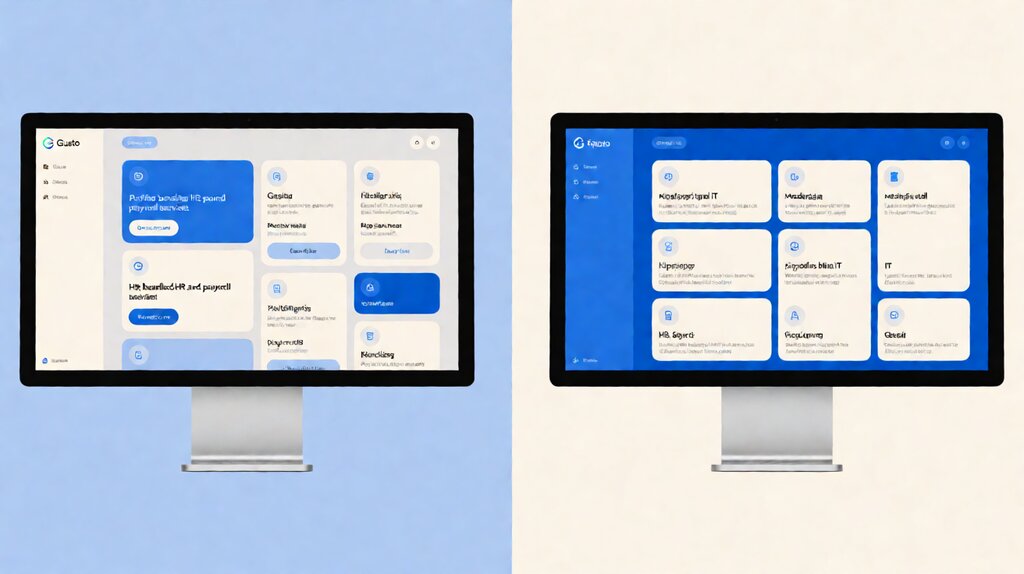

Rippling vs Gusto, for a small business that needs payroll, is mostly a comparison between Gusto’s specialized payroll-with-bundles approach and Rippling’s modular platform approach.
Gusto’s published pricing is transparent; Rippling’s published core-platform pricing is transparent ($8 per employee per month + $40 per month base), but Payroll is quote-only on Rippling’s own pricing page.
Gusto’s per-employee fee and tier upgrades are predictable; Rippling’s payroll fee is negotiated, with add-on modules per product (Time & Attendance, IT, Benefits, Performance) billed separately, often negotiated per customer.
Run a quick stress-test: if your small business needs payroll and possibly more later (HR, time tracking, IT device management, performance review, benefits administration), Gusto is the integrated payroll-with-extras approach and Rippling is the build-your-own-platform approach.
The “Payroll only” experience is roughly equivalent; the divergence happens when the second product arrives.
Gusto bundles benefits admin, HR, time tracking, and a CFO advisory call at the Plus tier.
Rippling unbundles all of these into separately priced modules.
Pick Gusto if your payroll-only needs will likely stay payroll-only with HR support. Pick Rippling if you are growing fast and want to add HR, time tracking, IT, and benefits modules on a flexible platform. Both handle full-service payroll at parity.
Key facts: Gusto Simple is $40/month base + $6/employee; Gusto Plus is $80/month base + $12/employee; Gusto Premium is $180/month base + $22/employee.
Rippling’s published Core platform starts at $40/month base + $8/employee; Rippling Payroll is quote-only as of October 2026 (Rippling’s own pricing page does not publish a USD figure).
Gusto’s free-form benefits admin and HR support are bundled at Plus; Rippling’s are separately quoted add-on modules.
Gusto’s Time Tracking is $5/employee/month extra; Rippling Time & Attendance is a separate module with quote-based pricing.
For 10 W-2 employees on payroll-only, the entry-tier bill is roughly: Gusto Simple $40 + $60 = $100/month, or Rippling $40 + $80 platform + Payroll (quote).
For 10 employees on payroll plus benefits plus HR support plus time tracking, Gusto Plus with bundled HR + benefits math grows to about $80 + $120 + $50 Time = $250/month, while Rippling’s modular scope quoted as a bundle often starts near $300-$400/month because each module is independently priced.
Pricing at published levels, October 2026
The numbers below come from each vendor’s published pricing page and the most recent review data. Rippling’s Payroll fee is published as “quote-only” since October 2025; the public-estimate range is “$8 to $40 per employee per month” depending on the modules added.
| Line item | Gusto | Rippling |
|---|---|---|
| Base platform fee | $40 — $180 (Simple / Plus / Premium) | $40 (single platform core) |
| Per employee (payroll included) | $6 / $12 / $22 | $8 (core) + Payroll quote |
| Time tracking | $5/employee/month extra | Time & Attendance module (quote) |
| Benefits admin | Bundled at Plus and above | Benefits module (quote) |
| HR support | Bundled at Plus; Premium adds dedicated HR | HR module (quote) |
| Multi-state filings | All 50 states included | All 50 states included |
| International payroll | Not supported | Supported in 50+ countries (quote) |
| IT device management | Not available | Supported as a module |
| Setup / onboarding | Self-serve or guided | Implementation manager + 1-3 weeks |
For the broader payroll definition and what each plan tier includes line by line, the full service payroll page walks through the included-and-excluded list.
For the per-employee fee math at each plan tier and per-state cost, the payroll service cost page runs the realistic monthly bill at each size.
For the broader payroll definition, the what is a payroll service page walks through the gross-to-net and deposits step by step.
What Gusto does better than Rippling, and vice versa
Neither is universally better; they excel at different operating models. The clearest pattern: Gusto wins on transparency, Rippling wins on flexibility.
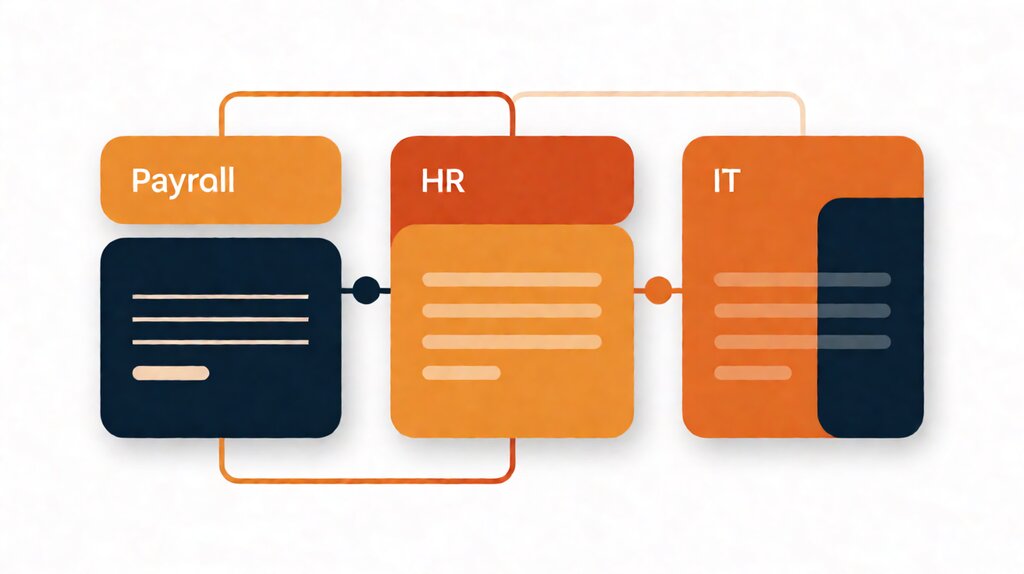
Gusto’s strengths. Published pricing on the website means you can predict your bill before you sign.
The Simple tier covers payroll + tax filing at $40 + $6/employee; the math is what it says.
Customer support is in-house (no separate contract); the support tier is responsive.
The integration with QuickBooks Online is at parity with other vendors; the integration with bookkeeping apps is broader than Rippling’s. Gusto has been a public company for years, which means financial transparency and a mature product.
Time tracking is a clean $5/employee/month extra, not a separately quoted module.
Rippling’s strengths. The platform philosophy is built for growth: you can add HR, time tracking, IT device management, performance review, and benefits admin as separately priced modules as the company grows.
The data model is unified across modules; an employee record created in payroll is the same record used in IT device assignment.
International payroll is supported in 50+ countries.
Customer support tiers vary, but the modular build means a growing company consolidates providers as it scales.
Gusto’s weaknesses. The full bundle stops at benefits admin and HR support; it doesn’t go deep on IT, performance, or international. For companies above 200 employees, Gusto’s tier becomes expensive per-employee.
Rippling’s weaknesses. The quote-based pricing on Payroll (and on most add-ons) is a transparency problem: you cannot predict the bill before the sales call. Customer support is reportedly inconsistent at scale; the modular complexity is real, and the implementation can stretch to 1-3 weeks.
Use Gusto when the company is payroll-first with HR support
Gusto’s best fit: small business that needs payroll right now, is unlikely to expand internationally in the next 12 months, and may add basic HR support, benefits admin, and time tracking at the Plus tier without needing IT or performance modules.
Best-fit profile for Gusto: 5-50 W-2 employees, single state or up to 3 states, US-only. Gusto Plus at $80 + $12/employee covers payroll + benefits admin + HR support + time tracking + basic HR advisory at $80 + $12 = ~$200/month for 10 employees.
For a 10-employee US-based consulting firm, restaurant group, or service business that wants predictable monthly cost and HR support without negotiating 4 vendor contracts, Gusto Plus is the obvious choice.
Use Rippling when the company is growth-first with payroll as one module
Rippling’s best fit: business that is growing fast, is likely to operate in 5+ countries, expects to add HR, IT, time tracking, performance, and benefits modules on a single platform, and is willing to negotiate a quote rather than compare published pricing.
Best-fit profile for Rippling: 25-200 employees, multi-state or multi-country, modular software buyer. A 50-employee startup with offices in 3 states and considering 2 international countries benefits from Rippling’s unified data model and global payroll reach. The bill is higher than Gusto Plus at the same headcount, but the modular scope covers HR + IT + global that Gusto cannot.
For a venture-backed SaaS startup above 50 employees with a distributed team, Rippling’s per-product quotes aggregate to a bill that grows with the modules you turn on. The platform isn’t cheaper; it’s more flexible.
The mid-size sweet spot is where the choice matters less
At 5-25 employees on payroll-only, the choice between Gusto Simple and Rippling’s published core platform is mostly a matter of UI preference.
Gusto’s $40 + $6/employee per month (~ $70 for 5 employees) is predictable.
Rippling’s $40 + $8/employee + Payroll quote is comparable but harder to predict until you sign.
For a 5-employee service business on payroll-only that will not add HR or international modules, Gusto’s transparency is worth $20-$30/month.
For a 5-employee international startup with contractors in 4 countries, Rippling’s global payroll module saves the cost of a separate global payroll vendor ($300-$500/month for a partner like Deel). The Rippling quote wins on consolidated vendor management.
What neither provider does well
Both have weak spots that small businesses should understand before signing.
International contractor payments. Rippling supports 50+ countries for employer-of-record but Rippling’s pricing for international contractors is quote-only. Gusto doesn’t support international contractor payments; you’ll need a separate vendor for that. Deel and Remote are the typical standalone options at $49-$500/contractor/month depending on country.
Multi-entity employer-of-record. Both providers typically handle one EIN per account; multi-entity ownership (an LLC plus an S-corp plus a separate LLC for the same owner) requires separate accounts or higher-tier support. Plan accordingly if you operate multiple entities; talk to the provider before signing.
International contractors with US payroll. Neither is ideal for the case where you have a US W-2 employee and an international contractor on the same platform. Rippling handles international but the per-country cost adds up. Gusto has no international footprint; you’d run payroll domestically and an invoicing + Deel separate path for international contractors.
Pick by use case
Pick Gusto if you can answer yes to all of: your team is US-only (or US + Canada at most), you expect 1-50 employees, you want transparent published pricing, and you don’t need IT device management or performance review modules.
Pick Rippling if you can answer yes to at least two of: your team is above 25 and growing above 100, you operate in 2+ countries, you want to consolidate HR + IT + payroll on one platform, or you accept quote-based pricing for the flexibility.
Pick a third option if you want either the lowest-cost payroll (Patriot Full Service at $37 + $5 = $62/month for 5 employees) or the broadest integrated benefits and PEO option (Justworks PEO at $56-$149/employee).
For the per-vendor comparison across the six credible full-service providers (Gusto, OnPay, QuickBooks Payroll, Patriot Full Service, ADP RUN, Paychex, plus Rippling as the modular alternative), the best payroll service for small business comparison runs the math at each employee count. For the broader Gusto vs QuickBooks Payroll comparison, the Gusto vs QuickBooks Payroll page covers the QuickBooks-integrated-business angle.
Last updated: October 2026