
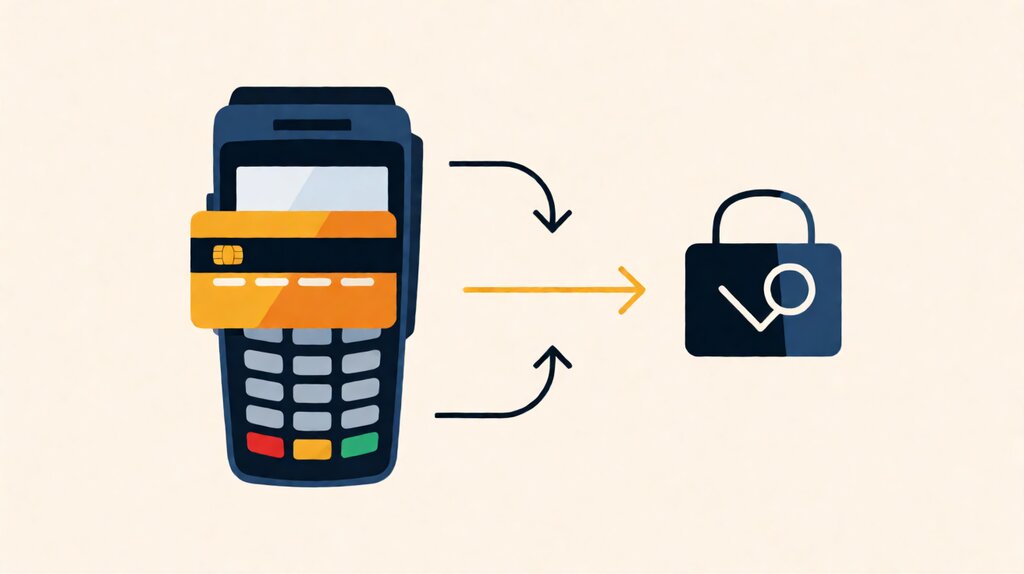

A payment processor is the third-party service that authorizes a customer’s card or bank payment, captures the funds, and settles them into your business bank account — minus a per-transaction fee.
The processor is the entity that connects the card networks (Visa, Mastercard, Amex, Discover) and the ACH network to your merchant account.
Without a payment processor, a small business cannot accept a card or a US bank transfer; without a clear understanding of how the processor charges, a small business cannot predict the cost.
Run a quick stress-test: the day you take your first card payment through Stripe, Square, or PayPal, the processor takes a percentage fee plus a per-transaction fixed fee (Stripe: 2.9% + 30 cents on a typical online transaction; Square: 2.6% + 10 cents in person; PayPal: 2.99% + 49 cents).
On a $50 invoice, that fee is $1.45 to $2.49 depending on the processor and the card type.
Across 100 invoices per month averaging $200 each, that is $290 to $500 per month in fees.
The processor model is the difference between a flat-rate “all cards treated the same” bill (Stripe, Square, PayPal) and an interchange-plus bill that ticks up and down with the card type and the way the customer pays (Stax, Payment Depot, Helcim).
A payment processor is the right move the first time you accept a card or US bank transfer from a customer. It is not necessary for cash-only or invoice-only businesses. For most small businesses, Stripe, Square, or PayPal is the default choice because they bundle gateway + processor + payout + dashboard for one flat-rate fee.
Key facts: A US payment processor authorizes the transaction through the card networks, captures the funds into the processor’s merchant account, and settles the net balance (gross minus fees) into your business bank account on a daily, weekly, or monthly schedule.
Flat-rate processors (Stripe, Square, PayPal) charge 2.6% to 2.99% plus 10 to 49 cents per transaction.
Interchange-plus processors (Stax, Payment Depot, Helcim) charge a smaller percentage (interchange + assessment + a small markup, often 0.25%-0.5% above true interchange) and are typically cheaper above ~$10,000/month in processing volume.
ACH transfer fees run $0 to 1.5% depending on the processor.
At $10,000 per month in card volume, a flat-rate processor charges about $290-$320 in fees; an interchange-plus processor charges about $250-$275. The cost difference at $50,000 per month widens to about $500-$700 per month saved with interchange-plus. At $5,000 per month or below, flat-rate usually beats interchange-plus because the per-flat-rate-economy is real on small volume.
How a payment processor actually works step by step
The mechanics look complicated the first time but resolve into six steps that happen on every card or bank transfer. Once you see the loop, the fee makes sense.
Step 1: customer initiates a payment. For card-not-present (online), the customer enters card details on your checkout page (Stripe Checkout, Square Online, PayPal Commerce). For card-present (in-person), the customer taps or inserts at your Square POS terminal. For ACH, the customer enters bank details and authorizes the debit.
Step 2: the processor routes the authorization request to the card network. The processor sends the card number, expiration, transaction amount, and merchant category code to the card network (Visa, Mastercard, Amex, Discover). The card network forwards to the issuing bank (the customer’s bank) for a yes/no on whether the customer has the funds and credit standing to authorize the charge.
Step 3: the issuing bank approves or declines. Approve is usually under 2 seconds. Decline reasons include insufficient funds, card closed, fraud flagged, or cardholder pressing cancel on a 3DS prompt. The processor receives the approval and forwards to the merchant.
Step 4: the merchant captures the authorization into a discrete transaction. For a typical e-commerce checkout, capture is automatic and immediate. For some platforms (hotel bookings, marketplaces), the merchant can pre-authorize at checkout and capture later (after shipment, after delivery).
Step 5: the processor batches transactions and settles net funds to the merchant bank account. At the end of each business day, the processor batches all approved-and-captured transactions, subtracts the fees, and either holds the net balance in the processor’s merchant account or initiates an ACH transfer to your business bank account.
Payout schedules vary: Stripe and Square payout daily (T+1 or T+2); PayPal payouts depend on account verification (instant, daily, weekly).
Step 6: the merchant reconciles payouts against the in-platform reporting. The processor’s dashboard shows each transaction’s authorization status, capture timestamp, gross amount, fee, net amount, and the linked payout batch. Most small businesses reconcile this against their bookkeeping (QuickBooks Online via the processor’s native connector or via Puzzle, Wave, Xero).
The four non-negotiables every payment processor must do
Before comparing providers on rate, confirm these four things. Every legitimate US processor offers them; the variance is depth, not whether they exist.
Card-network coverage. The processor must accept Visa, Mastercard, American Express, and Discover. Most US small business processors do; some exclude Amex (a separate network with higher interchange) or apply a premium for it. Confirm before signing if Amex is part of your customer mix.
Multi-channel acceptance (card-present, card-not-present, ACH). For a small business that wants to take online and in-person payments with one provider and one dashboard, the processor must support both. Stripe Terminal and Square POS cover both; PayPal Commerce is online-only for in-store use requires PayPal Zettle (international) or a third-party terminal.
ACH transfer support (for invoice-paid-via-bank). ACH is materially cheaper than cards ($0-$1 per transfer vs 2.6%-2.99% on cards) for invoices over $500. Most modern processors support ACH: Stripe ACH at 0.8% capped at $5; Square ACH at 1.5% with $1,000/day cap for Instant Deposit; PayPal ACH for invoice payment via their email-payment link. Confirm before signing.
Chargeback handling and dispute resolution. Every charge generates a chargeback risk. The processor must have a documented dispute submission process (upload evidence, present to issuer), a chargeback fee policy ($15-$25 per chargeback regardless of outcome), and an analytics dashboard showing chargeback ratio (the network-level threshold above which the processor can place holds or terminate).
Flat-rate pricing versus interchange-plus pricing
The choice between flat-rate (Stripe, Square, PayPal) and interchange-plus (Stax, Payment Depot, Helcim) is one of the most important decision in the cost calculation. They are not functionally equivalent; they are structurally different pricing models.
| Pricing model | How the fee is set | Best for | Risk profile |
|---|---|---|---|
| Flat-rate | Single percentage + fixed per transaction for any card type | Under $10k/month; new businesses; predictable monthly bill | Overpayment when most of your volume is low-cost debit cards |
| Interchange-plus (IC+) | Pass-through to interchange + assessment + acquirer markup | $10k+/month; businesses with mostly debit and pre-paid card mix | Variable bill when card mix shifts |
| Tiered pricing | Bundles card types into “qualified” vs “non-qualified” with different rates | Rarely chosen; opaque; sometimes the default on legacy accounts | Often the worst deal; overpayment on non-qualified cards |
| Subscription | Flat monthly fee covers all fees (e.g. Payment Depot $99/month with $0 per transaction) | $50k+/month; businesses with high volume who want predictable cost | Flat-rate subs disadvantage small volumes |
The cost math at each volume tier, including the surcharge for ACH-only processors and the surprise-fee math for interchange-plus, is laid out in detail in the payment processing fees page.
Where the fee money goes
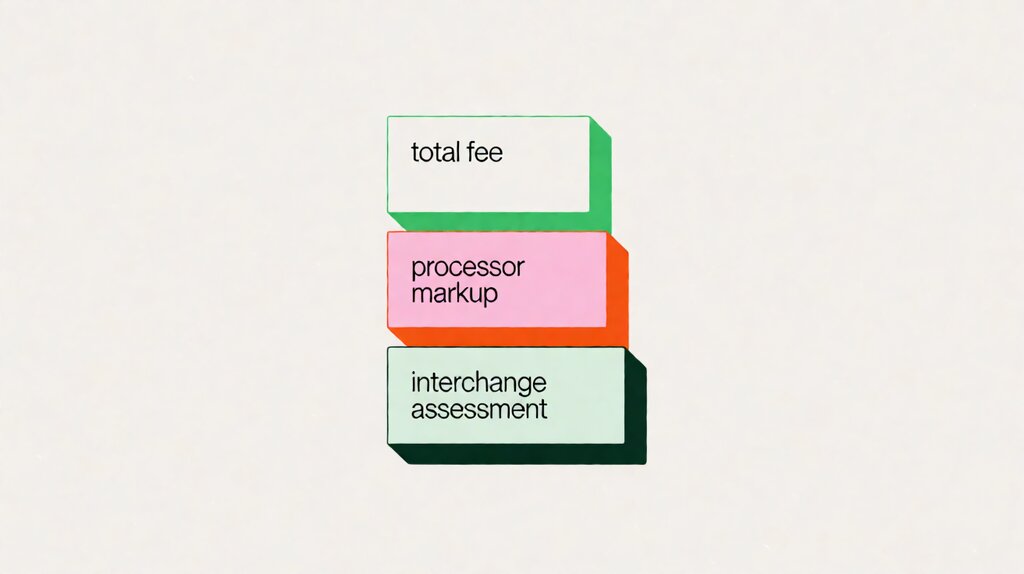
The processor keeps only a fraction of the per-transaction fee. The remainder goes to the card network and the issuing bank. This matters because interchange-plus pricing passes-through to these larger costs; flat-rate pricing absorbs them inside the percentage and small fixed fee.
Interchange fee (largest piece, typically 1.5%-2.5%). This goes to the issuing bank.
The fee varies dramatically by card type: debit cards at small tickets often interchange at $0.05 + 0.05% (regulatory cap from Durbin Amendment for some banks); consumer credit cards at 1.43% + $0.10 baseline; rewards cards at 1.65% + $0.10; premium rewards cards at 2.45% + $0.10; business credit cards at 1.85%-2.95%.
The interchange fee is set by the card network, not the processor.
Assessment fee (smaller, typically 0.13% to 0.15%). Goes to the card network itself (Visa, Mastercard). Set by the network.
Acquirer / processor markup (the variable the processor controls). This is the only piece the processor keeps. Flat-rate processors like Stripe take 0.5%-0.7% effective markup on a typical transaction; interchange-plus processors take 0.25%-0.5% markup. The difference is the cost gap between flat-rate and IC+ at any volume.
The flat-rate processor makes the markup simpler at the cost of giving up the savings on debit-card-heavy volume; the interchange-plus processor gives you the savings at the cost of a variable monthly bill.
Practical side effects a small business should know
Three mechanics that bite the first time around.
Payouts may not equal net of fees. Stripe’s standard payout schedule moves the gross amount net of fees to your bank; some processors hold back a percentage of gross and settle periodically. Read the payout schedule before your first transaction.
Chargeback fee is per chargeback, regardless of who wins. All reputable processors charge $15-$25 per chargeback initiated, regardless of whether the merchant wins. At 0.05% chargeback rate on $50k/month volume, that’s 3 chargebacks = $60-$75 per month.
Reserve holdback can be triggered by chargebacks, AML flags, or high-risk MCC. A merchant category code (MCC) for, say, firearms or adult entertainment almost always triggers a 5%-10% reserve holdback for 90-180 days. The reserve is the processor’s protection against unknown chargeback risk. For most SMB MCCs (retail, professional services, SaaS, ecommerce of physical goods), reserves are not automatically applied.
Pick the right processor for your volume
For the actual math at each volume tier and the per-card-type breakdown, the payment processing fees page runs the full cost comparison.
For the 3-way comparison of the three flat-rate leaders, the stripe vs square vs paypal page covers the practical difference.
For the definitional line between processor and gateway (and when the distinction matters for ecommerce vs in-person), the payment processor vs payment gateway page walks through it.
For the broader vendor comparison (Stripe, Square, PayPal, plus interchange-plus options) at each volume tier, the best payment processor for small business comparison covers the math.
Last updated: October 2026