
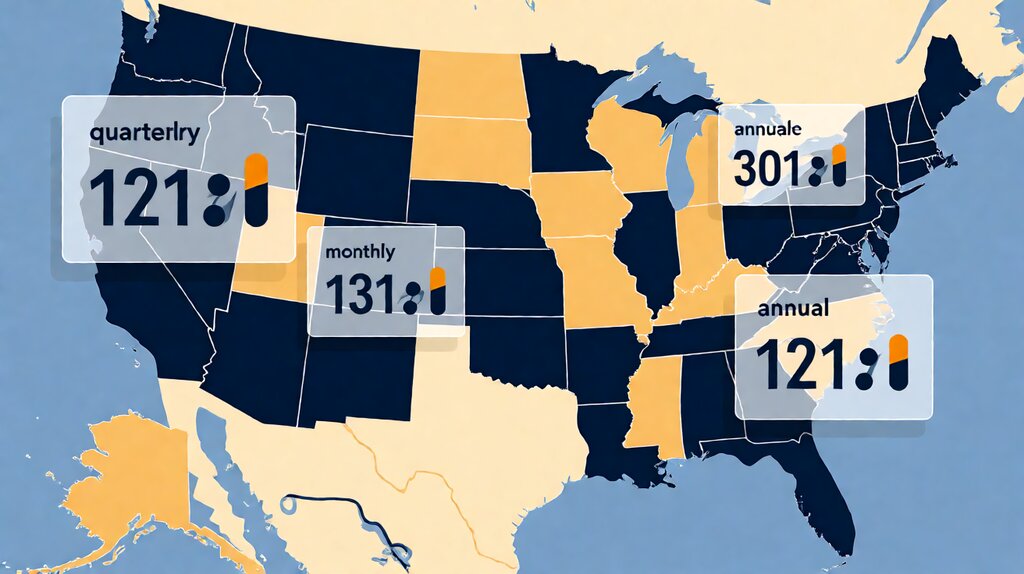

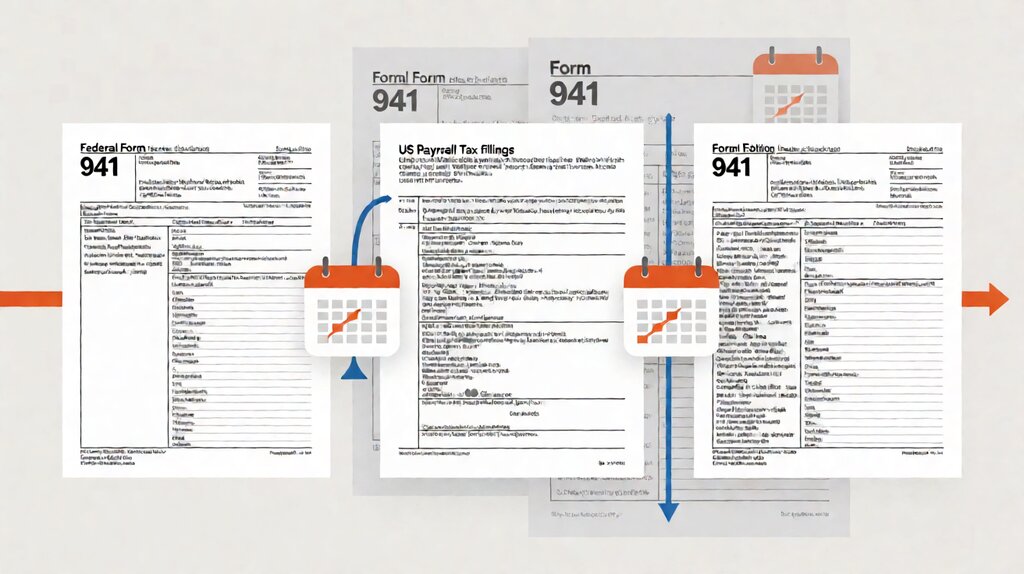
Small business payroll tax filing is the federal and state paperwork that accompanies running a payroll cycle: Form 941 quarterly, Form 940 annually, W-2s by January 31, and the parallel state-withholding and state-unemployment filings on each state’s own cadence.
The work is largely mechanical but the consequence of a missed filing or missed deposit is a $1,250-$12,500 penalty per occurrence, which is why almost every full-service payroll provider bundles the filings into the subscription fee.
Most small businesses never file payroll tax forms themselves; the payroll service does it on the LLC’s EIN.
Run a quick stress-test: if your LLC has W-2 employees, you are a federal and state employer of record.
The IRS doesn’t care that you have only 3 employees; the deadlines apply.
The IRS lookback rule determines whether you deposit federal taxes semi-weekly (every Wednesday for Tuesday payroll, every Friday for Friday payroll) or monthly (15th of the following month).
The lookback period is the prior 12 months ending June 30; if your federal deposit total exceeded $50,000 in that period, you are semi-weekly; otherwise monthly.
Small business payroll tax filing is the quarterly Form 941, the annual Form 940, the January W-2/W-3 batch, the state withholding remittance on the state’s cadence, and the new-hire reporting within 14-20 days. Filings are most safely done by a full-service payroll provider.
Key facts: Form 941 is the quarterly federal payroll tax return (April 30, July 31, October 31, January 31).
Form 940 is the annual FUTA (federal unemployment tax) return (January 31).
W-2 and W-3 are due by January 31 to the SSA and to employees.
State withholding remittance is monthly for most states with withholdings; quarterly for states without income tax (TX, FL, WY, etc.).
State unemployment (SUTA) is typically quarterly with annual reconciliation.
New-hire reports go to the state within 14-20 days; the federal W-4 alone is not enough.
A late Form 941 costs 5% of the unpaid tax per month late, up to 25%. A late federal tax deposit — even by 1 business day — costs 2% of the underdeposit. 6 months late on $5,000 of federal tax = $1,250 minimum penalty. With interest, the cost is materially higher than 12 months of full-service payroll fees.
The federal payroll tax filings
Three federal forms accompany a US payroll. Each has a different cadence and a different penalty structure.
| Form | Cadence | What’s on it | Penalty if late |
|---|---|---|---|
| Form 941 | Quarterly (April 30 / July 31 / October 31 / January 31) | Federal income tax withheld + FICA (Social Security 6.2% / Medicare 1.45%) + employer FICA match 7.65% | 5% per month late, up to 25%; minimum $50 per missed return |
| Form 940 | Annual (January 31) | FUTA 6% on first $7,000 per employee (effectively $42/employee) less state credit | 5% per month late, up to 25% |
| W-2 and W-3 | Annual (January 31) | Per-employee wage summary and W-3 aggregate for SSA | $50 per late W-2 ($250,000 max per year), $50 per late W-3 |
| EFTPS deposit | Semi-weekly (Wed/Fri) or monthly (15th) based on lookback rule | Direct deposit of withheld federal taxes into IRS account | 2% of underdeposit for 1-5 days late; up to 15% for 16+ days |
For the broader payroll definition and what each line on Form 941 actually represents in the payroll cycle, the what is a payroll service page walks through the gross-to-net math. For the S-corp owner-employee side of these filings (where the single W-2 is the owner-operator), the payroll for an LLC page covers the full-service requirements.
The IRS lookback rule and how it sets your deposit cadence
The IRS classifies you as semi-weekly or monthly depositor based on the prior 12 months ending June 30 of the previous year. If your federal-withholding + FICA deposits exceeded $50,000 in that lookback period, you’re a semi-weekly depositor; otherwise monthly. The classification is administrative, not optional, and resets the first January after the lookback evaluation.
Looking at a calendar-year small business that opened mid-year: the first January following the lookback will classify based on partial-year history. The IRS publishes the schedule in IRS Publication 8079 for each calendar year.
The classification matters because semi-weekly depositors face two deposit dates per week (every Wednesday for Tuesday-payroll, every Friday for Friday-payroll). Missing a date by 1 business day costs 2% of the underdeposit. Missing by 6-15 days costs 5%; missing by 16+ days costs 15%. Year-long accumulation of missed dates wipes out the savings of using self-service payroll for almost any small business.
The state filings: every state is different
Federal filings are uniform. State filings are not. The cadence and form vary by state, with five canonical shapes.
States with income tax and monthly withholding remittance. Most US states follow this shape. California EDD, New York DTF, Illinois DOR, Georgia DOR, Pennsylvania DOR all require monthly remittance by the 15th of the following month for state income tax withheld. Some allow quarterly remittance if state-withholding totals are below a threshold (typically $300-$500 in a quarter for many states).
States with no income tax and only SUTA remittance. Texas, Florida, Washington, Nevada, Wyoming, South Dakota, Tennessee (now has investment-only), New Hampshire. For these states the only state payroll tax is SUTA (state unemployment), remitted quarterly with annual reconciliation.
States with employer-side-only state tax. Oregon’s statewide transit tax on employee wages. Washington’s Cares Fund. These are tracked and deposited on the employer’s side even though the employee doesn’t see a withholding.
Local taxes (cities with their own levy). New York City has its own resident income tax. Pennsylvania has local Act 511 taxes that vary by municipality. Ohio has municipal income tax (~1.5% in most municipalities). These need separate filing if you have employees working in those cities, and the requirement often catches small businesses off-guard.
States with paid family / medical leave contributions. Washington (PFML), Massachusetts (PFML), Rhode Island (TDB), Colorado (FAMLI), Connecticut (FML), Delaware (PFL). These are employer and/or employee contributions to a state-run paid-leave fund; remittance cadence and rates vary.
New-hire reporting is the most-overlooked deadline
Every employer must report new hires to their state within 14-20 days of the employee’s first day.
The federal W-4 and state withholding form are not enough; the new-hire report goes to a state-managed directory used by the Office of Child Support Enforcement for child-support collection.
The deadlines and processes differ by state; most have a dedicated state portal or accept electronic submission through the payroll service.
The federal multistate registry (federal employer-new-hire) is automated when the state accepts the report and forwards it; small businesses do not need to file directly with the federal government.
Late new-hire reports carry smaller penalties than Form 941 misses ($25-$50 per late report in most states) but the cumulative record is what the state uses for child-support interception purposes.
What full-service payroll delivers on tax filing
The full-service tier on Gusto, OnPay, ADP RUN, Paychex Flex, QuickBooks Payroll Premium, and Patriot Full Service bundles the federal Form 941, Form 940, W-2/W-3, and the state withholding + SUTA filings (within the registered states) into the subscription fee. The state registration is the step that takes up to 30 days for the provider to set up; the filings then run automatically once registered.
What full-service does not cover: (a) state income tax returns for the LLC itself (Form 1120-S for S-corp, Form 1065 for multi-member LLC, Schedule C for sole-prop);
(b) state S-corp franchise taxes for the LLC itself (in California: $800 minimum, plus income-based);
(c) Form 1099-NEC state filings (some states have state-issued 1099s; the federal 1099-NEC is part of the payroll service,
but state-level 1099s are filed separately). All three categories are LLC income-tax filings, not payroll-tax filings; they belong to the LLC’s accountant.
Year-end reconciliation: the operational detail
The first week of January is the year-end reconciliation. Three things happen in order, and most payroll services orchestrate them.
W-2 draft generation. The payroll service compiles each employee’s W-2 from the payroll register for the year. Drafts are available in the dashboard by mid-January.
W-2 verification and approval. You verify name, SSN, total wages, federal income tax withheld, and state withholding boxes. Corrections before January 31 are free; after that, W-2c reprints run $5-$20 per W-2 depending on provider.
W-3 issuance to SSA. W-3 is the aggregate form sent to the Social Security Administration alongside the W-2 copies. The provider files W-3 by January 31; missing this carries a $50 penalty. Most providers file both W-2 and W-3 electronically.
Once the W-2 is filed, the cycle closes. The next cycle (W-2 2026) begins with the first payroll period starting January 1, 2027.
Pick the right tier for tax filing at your company size
Self-service payroll. You file the federal Form 941 and Form 940 yourself. You use EFTPS to make the federal tax deposits. You submit the state returns yourself. Patriot Basic at $17/month base + $4/employee is the canonical sub-$50/month option. The cost of the service is the time investment to do the filings correctly.
Entry-tier full service. The provider files Form 941 and Form 940 quarterly and annually, and files the W-2/W-3 batch. State filings are included for the registered states. Gusto Simple at $40 + $6 per employee is the standard choice at this tier.
Premium tier. Premium tier adds dedicated support, hour-1 phone response, proactive compliance alerts, and the right handholding when something goes wrong. Premium tier is $40-$50 more per month than entry tier. Worth it for owners who are not payroll people.
PEO. The PEO files under its own EIN; the employer’s filings reduce. Justworks, ADP TotalSource, and TriNet are the typical PEO choices at this scale.
For the comparison across the six credible full-service providers at each employee count and at each tax-filing orientation, the best payroll service for small business comparison runs the numbers.
For the broader payroll definition and how the math works, the what is a payroll service page walks the gross-to-net and the deposits step by step.
For the per-employee and per-state fee math that the vendor sites hide, the payroll service cost page covers the realistic monthly bill at each size.
Last updated: October 2026