
Ecommerce platform for B2B wholesale depends on the catalog depth, the per-customer pricing complexity, the quote-to-cash workflow, and the payment methods (PO vs credit card vs net terms). For SMB B2B / wholesale operators with 1,000+ SKUs, multiple price lists, customer groups (distributor vs retailer vs end-buyer), and net-30 / net-60 / net-90 payment terms, BigCommerce is the canonical answer — the platform’s native B2B Edition handles customer-specific pricing, customer groups, quote-to-cash, and the per-customer catalog. For SMBs starting lighter (under 200 SKUs, single price list), Shopify + a B2B app (Shopify Plus is enterprise-scale; Shopify Markets + apps at lower tiers) is a workable alternative. For SMBs that need a custom B2B storefront with full ERP integration, Magento / Adobe Commerce is the deep alternative; the platform cost is $10K-$50K+/year for SMB.
Run a quick stress-test: a US wholesale distributor selling industrial supplies with 1,500 SKUs, three price lists (distributor / retailer / end-buyer), and net-30 terms to most buyers. On BigCommerce Standard at $39/month + Stripe, the operator gets the customer-specific pricing, the customer groups, the quote-to-cash, and the net-30 workflow (Stripe Capital can offer net-term financing for eligible buyers). The total platform + gateway is ~$1,089/month at $30K monthly GMV. Compare to Shopify Plus at $2,300/month (the SMB Plus tier for B2B), which adds another $21,732/month. BigCommerce wins for this scenario.
Pick BigCommerce Standard or Pro for a B2B / wholesale operator with 1,000+ SKUs and customer-specific pricing. Pick Shopify Plus if you’re an SMB already on Shopify moving toward B2B. Pick Magento / Adobe Commerce for full enterprise B2B ecommerce with ERP integration; budget $10K-$50K+/year for hosting + agency.
Key facts: BigCommerce B2B Edition is the canonical SMB B2B / wholesale platform. Native customer-specific pricing, customer groups, quote-to-cash, net terms (net-30/60/90) via Stripe Capital or partner integrations, multi-currency for international buyers. BigCommerce Pro at $399/month adds multi-storefront capability (the operator can run a B2C store + a B2B / wholesale store on a single backoffice). For Magento / Adobe Commerce, the platform cost is enterprise-scale; the SMB-tier answer is BigCommerce or Shopify Plus. For a smaller B2B operator (under 200 SKUs, single price list), Shopify + a wholesale app (Wholesale Pricing, Bold Custom Pricing) is workable.
A US B2B wholesaler at $30K monthly GMV with 1,500 SKUs, multi-tier pricing, and net-30 terms: BigCommerce Standard at $39/month + Stripe 2.9% + $0.30 = $1,089/month total. Shopify Plus at $2,300/month + Shopify Payments 2.5% + $0.30 = $3,120/month. Magento / Adobe Commerce at $10K-$30K/year hosting + agency = $830-$2,500/month. The cost advantage at this volume is on BigCommerce.
How B2B ecommerce actually works step by step
The mechanics resolve into seven steps that happen at each B2B order. The flow differs from B2C in five key places.
Step 1: buyer login + customer-specific catalog. The buyer logs in with their account (not a guest checkout). The platform shows the customer’s catalog with their specific pricing — tier-discounted, volume-discounted, customer-specific. BigCommerce’s B2B Edition handles this natively; Shopify needs an app for full functionality.
Step 2: customer-specific cart. The buyer adds products; the cart shows their customer-specific pricing and any volume discounts. The platform may show tier-2 pricing at the cart level (or the quote level, per config).
Step 3: quote request (if quote-to-cash). For large orders, the buyer may request a quote. The platform routes the quote to the SMB’s sales rep; the rep creates a quote with negotiated pricing; the buyer reviews and accepts or revises.
Step 4: order approval (for purchasing managers). In B2B, the buyer (the requester) is often different from the approver (the manager). The platform supports order approval flows — the requester submits, the approver approves, then the order ships.
Step 5: invoice + net-term payment. The platform generates an invoice (not a charge-at-checkout) with net-30/60/90 terms. The buyer pays via check, ACH, or wire transfer on the due date. BigCommerce integrates with NetSuite, QuickBooks, and Sage for the invoice-to-cash flow. Stripe Capital offers net-term financing for buyers below a credit threshold.
Step 6: ship + deliver (often with carrier-account billing). For B2B, the buyer often has a UPS / FedEx account and the SMB ships on the buyer’s account via collect billing. The platform generates the label on the buyer’s carrier account.
Step 7: integration to ERP / accounting. The platform posts the order + invoice + payment status to the SMB’s ERP (NetSuite, SAP, Sage, Microsoft Dynamics). The integration is critical for B2B; most SMBs use an integration platform (Celigo, Boomi, Workato) or a native integration.
What makes B2B ecommerce different from B2C
Five structural differences between B2C and B2B ecommerce platforms.
Customer-specific pricing and catalogs. The B2B SMB needs different prices for different customer groups (distributor at -40%, retailer at -25%, end-buyer at retail). Each customer group may also have a different catalog (some SKUs hidden from distributor, some hidden from retailer).
Quote-to-cash flow. The buyer requests a quote for a large order; the SMB’s sales rep creates a custom-priced quote; the buyer accepts, and the quote becomes an order. The flow is B2B-specific; B2C doesn’t have it.
Net-term payment (PO invoicing). The buyer pays on net-30/60/90 — not at checkout. The platform supports purchase orders (POs), invoice generation, and ACH / wire / check payment. Stripe Capital offers buyer financing for smaller buyers; for larger buyers, the SMB handles credit decisions offline.
Multi-currency for international buyers. B2B buyers may be international. The platform handles multi-currency display, conversion, and settlement. BigCommerce Pro includes native multi-currency; Shopify Markets includes multi-currency for paid tiers; Magento handles multi-currency natively.
ERP integration. B2B orders are typically 100x larger than B2C orders (a $50K PO is more common than a $50K shopping cart). The platform integrates to the SMB’s ERP (NetSuite, SAP Business One, Sage Intacct, Microsoft Dynamics) for inventory sync, invoice posting, and customer credit management. The integration is typically a middleware (Celigo, Boomi) or a native connector (BigCommerce + NetSuite connector, Shopify + NetSuite connector).
The three SMB B2B ecommerce shapes
Three profiles cover most SMB B2B operators.
Mid-market B2B with 1,000+ SKUs and multi-tier pricing: BigCommerce Standard or Pro. The canonical pick. Native customer-specific pricing + customer groups + quote-to-cash + net-term support. The BigCommerce + NetSuite (or + Sage / + QuickBooks) integration handles the invoice-to-cash flow. The total platform cost is $39-$399/month + Stripe = $1,089-$3,500/month at typical SMB B2B GMV.
Shopify B2B add-on for SMBs already on Shopify: Shopify + apps, with Shopify Plus for SMB Plus tier. Shopify’s B2B ecosystem is less mature than BigCommerce’s; SMBs use apps (Wholesale Pricing, Bold Custom Pricing, Lock Suite) for the customer-specific pricing + catalog features. The total cost is higher than BigCommerce at $50K+ monthly GMV.
Magento / Adobe Commerce for enterprise B2B: budget $10K-$50K+/year. The deep customization is unmatched; the operational complexity matches. For SMB B2B operators with the budget and the technical staff, Magento is the canonical pick. The platform runs Magento Open Source (free) + hosting + agency + ERP integration. The total cost is materially higher than BigCommerce or Shopify but the customization is unmatched.
B2B / wholesale operational specifics
Three specialized considerations for B2B operators.
Buyer credit checks. Most B2B operators run credit checks on new buyers before extending net-terms. Stripe Capital handles buyer credit decisions for SMB-eligible buyers; for larger buyers, the operator’s AR team decides. The credit limit and the net-term days are part of the customer’s account record.
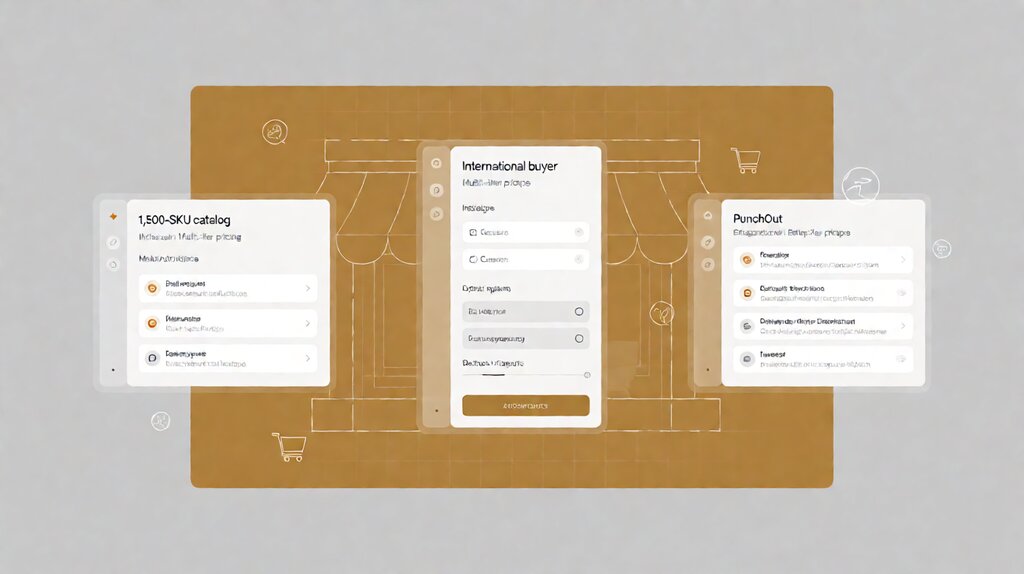
PunchOut. Larger B2B buyers (Fortune 500 enterprise procurement) often use PunchOut — a protocol where the buyer’s procurement system (Coupa, Ariba, SAP) connects to the SMB’s catalog via the OCI / cXML protocol. PunchOut is a feature in BigCommerce Enterprise and Magento; for true PunchOut capability, the SMB needs to budget $15K-$50K+ for the integration.
Custom catalogs per buyer group. Different buyer groups see different SKUs at different prices. BigCommerce’s customer groups + customer-specific pricing handles this natively; for Shopify, an app is needed.
The cost math at each B2B scale
Three profiles cover most SMB B2B / wholesale operators.
$10K monthly GMV / 50 orders at $200 AOV. BigCommerce Standard = $39 + 50 x ($0.30 + 2.9% x $200) = $39 + $305 = $344/month. Shopify + Wholesale apps = $39 + $0.30 + Wholesale Pricing app + Stripe = ~$300-$400/month. Magento at this GMV is overkill.
$50K monthly GMV / 250 orders at $200 AOV. BigCommerce Pro = $399 + 250 x $6.10 = $399 + $1,525 = $1,924/month. Shopify Plus = $2,300 + Shopify Payments at lower rate = ~$2,000-$2,300/month. Magento at this GMV is competitive on cost (hosting + agency).
$200K monthly GMV / 800 orders at $250 AOV. BigCommerce Pro or Enterprise = $399-$1K + Stripe = ~$3,500-$5,000/month. Shopify Plus negotiated pricing = $2,000-$4,000/month at this volume. Magento / Adobe Commerce with agency is the customization-most answer.
What about wholesale marketplaces
Two wholesale-marketplace alternatives for SMBs that want discovery + scale at cost of margin.
Amazon Business. The B2B / wholesale version of Amazon. Free to join, 15%-17% referral fee per order (same as Amazon B2C), plus the SMB operates the fulfillment (FBM or FBA Business). For SMBs that want instant discovery + enterprise procurement integration, Amazon Business is the path.
Faire. The wholesale marketplace for boutique brands (fashion, jewelry, home goods). Faire connects SMBs with boutique retailers; the SMB sells on consignment, Faire takes a commission (25% of order value + 15% re-stocking fee on returns). Best for SMBs with strong design aesthetic and low-volume boutique channels.
These wholesale marketplaces give SMBs discovery + scale, but they cost the SMB 15-25% of order value (margin loss). The hybrid model — BigCommerce / Shopify + Amazon Business + Faire + the SMB’s direct B2B store — covers multiple buyer types at the cost of operational complexity.
Practical implications for a small business
Three decisions follow from choosing a B2B / wholesale ecommerce platform.
“Which payment gateway pairs with the platform?” Stripe direct is the canonical gateway on BigCommerce (no platform per-transaction fee). For Magento, the SMB’s choice is Stripe / Adyen / Braintree / Authorize.Net. For Shopify Plus, Shopify Payments is cheapest.
“How is sales tax handled across states?” The B2B operator’s sales tax is nexus-based; not every state taxes wholesale. TaxJar handles the calculations + filings for SMB B2B operators. Avalara is the enterprise alternative at $200+/month.
“What about ERP integration?” The SMB’s accounting/ERP (QuickBooks Online, Xero, NetSuite, Sage) is the canonical integration. BigCommerce has native connectors to QuickBooks Online + NetSuite; Shopify has apps for QuickBooks + NetSuite; Magento has bidirectional connectors to all major ERPs.
Pick the right B2B ecommerce platform
Pick BigCommerce Standard or Pro if you’re a B2B / wholesale operator with 1,000+ SKUs and customer-specific pricing. The canonical pick.
Pick Shopify Plus + apps if you’re an SMB already on Shopify moving toward B2B. The SMB-tier alternative.
Pick Magento / Adobe Commerce if you need full enterprise B2B with ERP integration. Budget $10K-$50K+/year.
Add Amazon Business + Faire if you want wholesale discovery + scale at cost of margin.
For the B2C counterpart (DTC brand at $5K-$100K monthly GMV), the ecommerce platform for small business page covers the canonical picks. For the practical 3-way vendor comparison on tier and features, the Shopify vs BigCommerce vs WooCommerce page runs the comparison. For the cost math at each GMV tier, the ecommerce platform pricing page covers the math. For the structural distinction between ecommerce platform and a marketplace, the ecommerce platform vs marketplace page covers the distinction. For the broader vendor coverage (Wix, Squarespace, Ecwid, Magento, Adobe Commerce) at each volume tier, the best ecommerce platform for small business comparison covers the math.
For the payment-processor cost math that drives the gateway fees across platforms, the payment processing fees explained page covers the per-transaction math at each processor tier. For the Stripe Capital buyer-financing feature for SMB B2B operators, the broader provider comparison is on the Stripe Billing vs Chargebee vs Recurly page (Stripe Capital is a separate Stripe product, not Stripe Billing; the link is a context reference for the broader Stripe platform).
For the broader payment-processor fee comparison that drives the gateway choice on BigCommerce, Shopify, or Magento, the payment processor fee comparison covers the per-transaction math at each processor tier.
Last updated: October 2026