
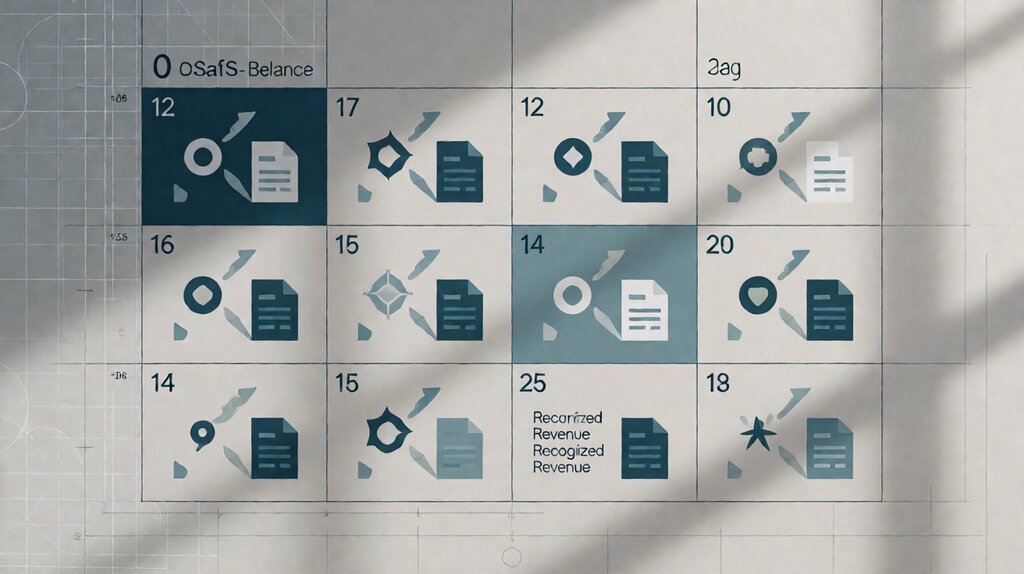

SaaS revenue recognition under ASC 606 (the FASB’s revenue-from-contracts-with-customers standard, effective for public companies from 2018 and private companies from 2019) requires SaaS revenue to be recognized over the service delivery period, not at the moment of charge.
For a $1,188 annual subscription paid in full at sign-up, the SaaS operator recognizes $99/month for 12 months — not $1,188 in the month of payment.
For a $49/month subscription with a 14-day free trial, the operator recognizes $1.63/day from the trial-end date onward.
The mathematical effect: cash-basis accounting recognizes at charge; accrual-basis accounting (the default for funded SaaS) recognizes over delivery.
Run a quick stress-test: a SaaS operator collects $50K in December via annual subscriptions paid up front.
Cash-basis accounting recognizes $50K in December.
Accrual-basis accounting (per ASC 606) recognizes $4,167 in December, $4,167 in January, $4,167 in February, … $4,167 in November.
The reported revenue differs by $45,833 in December and is the same $50K over 12 months.
The accounting does not change the cash position; it changes the timing of reported revenue.
For SaaS companies selling annual plans (which most B2B SaaS do), this is the largest gap in their financial reporting.
SaaS revenue recognition under ASC 606 requires revenue to be recognized over the service delivery period, not at the moment of charge. A $1,188 annual subscription paid up front is recognized $99/month for 12 months. A $49 monthly subscription is recognized $49 in the billing month. The accounting does not change cash; it changes the timing of reported revenue.
Key facts: ASC 606 is the FASB revenue recognition standard effective US public 2018, private 2019.
IFRS 15 is the international equivalent.
The five-step model: (1) identify the contract, (2) identify the performance obligations, (3) determine the transaction price, (4) allocate the transaction price to the performance obligations, (5) recognize revenue when (or as) each performance obligation is satisfied.
For SaaS, the single performance obligation is “ongoing access to the software service”, recognized ratably over the access period.
Multi-element contracts (SaaS + setup + training) require allocation.
The accounting-effect for SaaS: annual subscriptions create deferred-revenue on the balance sheet; monthly subscriptions rarely do.
Stripe Revenue Recognition, Chargebee’s accounting export, and Maxio (formerly SaaSOptics) bundle the journal entries.
For a US SaaS operator doing $40K MRR with 60% annual contracts (a typical B2B SaaS mix), the cash-basis vs accrual-basis gap runs $15K-$30K per month depending on the size of the annual contract cohort. The deferred-revenue balance sheet line shows the difference. Most funded SaaS companies report under accrual; the deferred-revenue balance is a key metric for investor due diligence.
The five-step model in plain language
ASC 606 defines a five-step model that every SaaS contract must walk through to recognize revenue correctly.
Step 1: identify the contract. A contract is “an agreement between two or more parties that creates enforceable rights and obligations”. For SaaS, this is the signed customer agreement (electronic signature, per the cluster’s ESIGN Act framework). A free trial is typically not a contract (no consideration exchanged); the contract starts when the customer makes the first payment.
Step 2: identify the performance obligations. The promised goods or services. For a single SaaS subscription, this is “ongoing access to the software service”. For a multi-element contract (SaaS subscription + setup + training + support), each is a separate performance obligation. A pure SaaS subscription is typically a single obligation — recognized ratably over the access period.
Step 3: determine the transaction price. The amount of consideration the SaaS expects to receive. For fixed-fee SaaS, this is the subscription fee. For usage-based SaaS (e.g., a metered API at $0.01 per call), the transaction price is variable consideration and may need estimation.
Step 4: allocate the transaction price to the performance obligations. For multi-element contracts, allocate based on standalone selling prices. For a SaaS + setup + training package, allocate the $99/month bundle price based on the standalone price of each element.
Step 5: recognize revenue when (or as) each performance obligation is satisfied. For a single SaaS subscription obligation, “satisfied” happens continuously over the access period. Revenue is recognized ratably ($99/month for a $1,188 annual subscription).
The five-step model, applied to a typical SaaS subscription, results in the canonical ratable recognition. The complexity enters when a SaaS has multi-element contracts or usage-based pricing.
How ASC 606 specifically applies to SaaS subscription billing
The mechanics resolve into three patterns that cover most SaaS contracts.
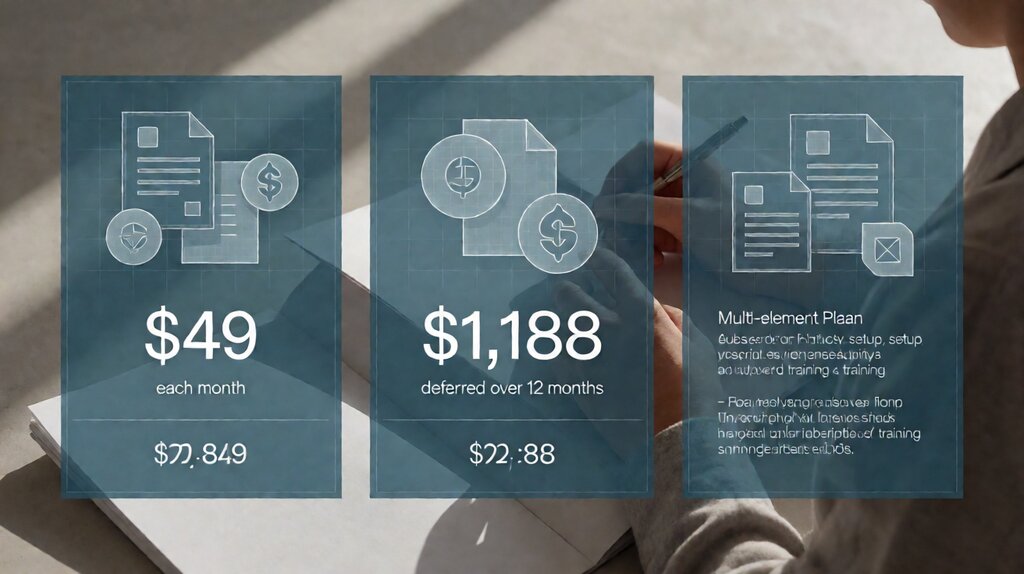
Monthly subscriptions: $49 charged each month. Recognize $49 in the billing month. Cash and accrual align. No deferred revenue because the customer paid at the start of the period for that period’s service. This is the simplest case.
Annual subscriptions: $1,188 paid up front for 12 months of access. Recognize $99/month for 12 months. At the time of payment, $1,188 hits the cash account and $1,188 hits the deferred-revenue liability on the balance sheet. Each month, $99 is moved from deferred revenue to recognized revenue. At the end of 12 months, deferred revenue is zero.
Multi-element contracts: SaaS + setup + training. Allocate the bundle price to each performance obligation based on standalone selling prices. Recognize SaaS access ratably, setup service at the time of delivery, training at the time of delivery. The sum of recognition across all elements equals the bundle price over the customer lifetime.
For the operator, the operational reality is that subscription billing software (Stripe Revenue Recognition, Chargebee, Maxio) generates the journal entries. Without the platform, the operator’s accounting team would manually journal each subscription each month — a manual workload that scales linearly with subscriber count.
Deferred revenue: the balance-sheet line for SaaS
The most visible effect of ASC 606 on a SaaS balance sheet is the deferred-revenue line. It shows the gap between cash collected and revenue recognized.
Mechanics. When a SaaS operator collects a $1,188 annual subscription, $1,188 hits cash and $1,188 hits deferred revenue (a liability). Each month, $99 moves from deferred revenue to recognized revenue. The deferred-revenue balance at any point is “the sum of all annual subscriptions paid for future periods”.
Magnitude. For a SaaS operator with $40K MRR and 60% annual contracts, the deferred-revenue balance at any point is roughly $144K (12 months x $12K annual contract cash/month x 60% annual share). The figure can grow materially as the SaaS grows.
Disclosure. Public SaaS companies disclose deferred-revenue growth as a leading indicator of revenue. The deferred-revenue balance at quarter-end is part of earnings; investors use it to validate the recurring-revenue story.
IFRS 15: the international equivalent
IFRS 15 is the international accounting standard for revenue recognition, issued by the IASB. The IFRS 15 model is essentially identical to ASC 606 (the FASB and IASB converged on the standard). The differences are minimal and surface mostly in:
Effective-date difference. IFRS 15 was effective from January 2018; ASC 606 from 2018 for public US companies and 2019 for private. Both are now in effect.
Disclosed terminology. IFRS uses “contract liability” where ASC 606 uses “deferred revenue”. Same balance-sheet concept, different name.
Specific revenue recognition interpretations. Some edge cases (variable consideration, contract modifications) have slightly different interpretations under IFRS 15 vs ASC 606; for most SaaS contracts, the practical effect is identical.
For a SaaS operator selling globally, IFRS 15 governs the entity-level financials in IFRS-reporting jurisdictions; ASC 606 governs US-GAAP-reporting entities. Multinational SaaS companies typically adopt one of the two, with reconciliation disclosures.
Stripe Revenue Recognition vs Maxio vs manual journal entries
Three approaches to generating the journal entries for SaaS revenue recognition.
| Approach | Cost | Setup effort | Best for |
|---|---|---|---|
| Stripe Revenue Recognition | $0.50/month minimum + 0.25% of revenue | Low (Stripe native) | SaaS using Stripe as payment processor |
| Chargebee + accounting export | Chargebee subscription fee + 0.5-1.5% per transaction | Medium (setup of export) | SaaS on Chargebee billing |
| Maxio (formerly SaaSOptics) | $1.5K-$5K/month + per-subscriber fee | Medium-High (Quarter-close setup) | Mid-market+ SaaS with complex contracts |
| Manual journal entries | In-house accounting cost | High (every contract, every month) | Below 50 subscribers, annual contracts only |
For a SaaS operator below 50 subscribers, manual journal entries are feasible and free. At 200+ subscribers, a billing platform’s revenue recognition module is the canonical answer; the manual workload exceeds the platform cost.
Sales tax + VAT in the SaaS revenue recognition model
Two adjacent concerns that interact with ASC 606.
Sales tax in the US. SaaS is taxable in most US states with economic-nexus rules (e.g., Wayfair vs South Dakota). For a US SaaS operator selling in 30 states, the operator is responsible for calculating, collecting, and remitting the right sales tax per state. Stripe Tax (a Stripe Billing add-on) handles the calculation and collection at $0.50/month minimum; TaxJar / Avalara are competitors.
VAT in the EU. SaaS sold to EU consumers is subject to VAT at the customer’s member-state rate. Operators with EU nexus (selling to EU customers from a US entity) typically register for the EU One-Stop-Shop and file a single quarterly return. Stripe Tax handles EU VAT collection.
For sales tax and VAT, the operator’s collection obligation is separate from ASC 606 revenue recognition.
The two interact through the same payment: when a US customer pays $1,188 for an annual SaaS subscription, the operator collects sales tax on top (which is a passthrough to the state), recognizes $1,188 ratably under ASC 606, and remits the sales tax quarterly to the state.
The platform (Stripe Billing + Stripe Tax) handles both.
Practical implications for a small SaaS
Three decisions follow from the ASC 606 framework for a small SaaS operator.
“Do I need revenue recognition at my MRR level?” Below 50 subscribers with no annual contracts, manual journal entries are feasible. At 200+ subscribers or with annual contracts, a billing platform (Stripe Revenue Recognition, Chargebee accounting export, Maxio) is the right answer; the deferred-revenue balance and the journal entries scale with subscriber count.
“How do I report deferred revenue on my financial statements?” Deferred revenue is a current liability (within 12 months) plus a non-current liability (longer than 12 months). For annual subscriptions, the entire amount is current. For multi-year subscriptions, the current portion is the 12-month portion and the rest is non-current.
“Do I need ASC 606 compliance for tax purposes?” ASC 606 governs financial reporting, not tax reporting. The IRS (and state tax authorities) may recognize revenue under different rules. Verify with a tax professional for state-specific revenue recognition rules.
For the cost math at your MRR level and the per-vendor fee structure, the subscription billing pricing page covers the math.
For the practical comparison of the three canonical subscription billing vendors at each MRR tier, the Stripe Billing vs Chargebee vs Recurly page runs the comparison.
For the broader SaaS setup flow (signup, dunning, proration, portal) at the operational layer, the what is subscription billing page covers the lifecycle.
For state-by-state or country-specific sales tax / VAT specifics, this article is not tax or accounting advice; ASC 606 has specific interpretive guidance that varies by industry and contract type. Consult a CPA familiar with SaaS accounting before relying on the framework above for filings.
For the broader vendor comparison at the platform tier (Stripe Billing / Chargebee / Recurly) and the answer for your MRR level, the best subscription billing software for small business comparison covers the practical differences at each plan.
For the structural distinction between subscription billing and recurring payments (and when each fits), the subscription billing vs recurring payments page walks through the distinction.
For the underlying processor fee math that affects deferred revenue, the payment processing fees explained page covers the per-transaction math.
Last updated: October 2026