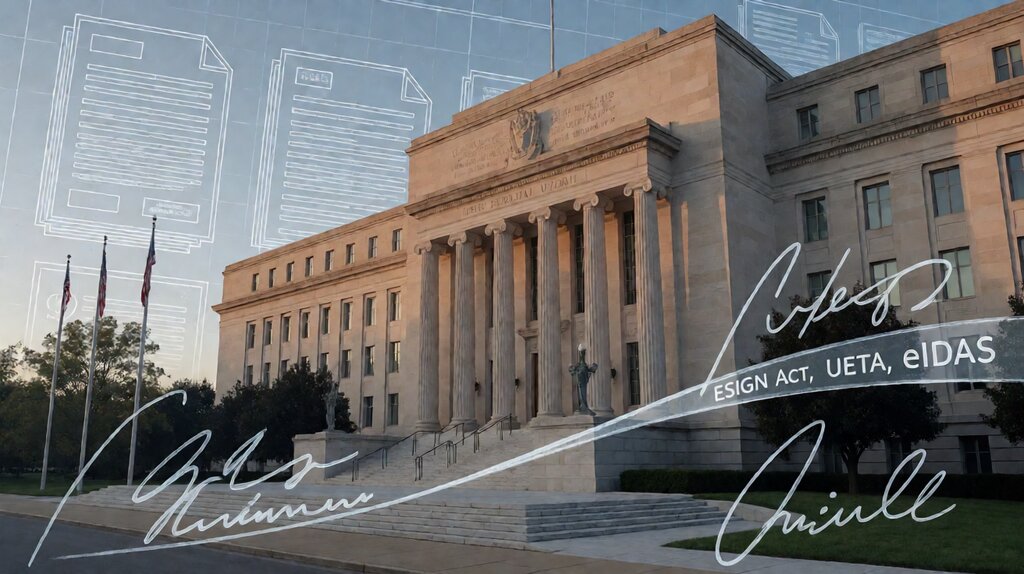

Electronic signatures in the United States are governed by the federal ESIGN Act (Electronic Signatures in Global and National Commerce Act, 2000) and the state-level Uniform Electronic Transactions Act (UETA, 1999, adopted by 49 states). For the EU, the regulation is eIDAS (electronic IDentification, Authentication and trust Services, 2014, recast 2024). Together these statutes give electronic signatures the same legal standing as wet-ink signatures provided three conditions are met: intent to sign, consent to do business electronically, and record retention.
Run a quick stress-test: the day you upload a contract PDF to DocuSign and the signer clicks “Adopt signature” in their email, the platform captures four legally required artifacts: (1) the signer’s identity (email + IP + device fingerprint), (2) the document hash at signing (proving content integrity), (3) intent (the click-to-adopt action, not a passive checkbox), and (4) consent (the agreement to do business electronically was made when the sender used the platform’s electronic-consent disclosure). Those four artifacts together are the legal basis for treating the e-signature as equivalent to wet-ink.
Electronic signature laws in the US are the federal ESIGN Act and state UETA. In the EU the regulation is eIDAS. The statutes give e-signatures legal standing under three conditions: intent, consent, record retention. Beyond that, each statute adds its own tiers and exceptions (EU qualified signature, US healthcare/HIPAA, real estate, federal filings).
Key facts: ESIGN Act (US, federal, 2000) makes electronic signatures legally equivalent to wet-ink for interstate commerce. UETA (US state-level, 1999) does the same for intrastate; adopted by 49 states (New York is the only state that has not formally adopted UETA but accepts electronic signatures under its own statute ESTA 2020). eIDAS (EU, 2014, recast 2024) defines three tiers: simple, advanced, qualified. For most US SMB contracts, ESIGN + UETA + the platform’s audit trail is the entire legal framework. State-by-state notarization and witness requirements still apply for real estate, estate planning, and some healthcare documents.
For an SMB that signs 25 contracts a month across most US states, ESIGN + UETA covers the legal framework. The exceptions are: real estate closing (many states require in-person notarization or RON via approved platform); estate documents (wills and trusts often require wet-ink witnesses); certain healthcare consent forms (HIPAA covers consent to treatment per state; eID is acceptable when platform records sufficient audit trail); and Federal filings (FDA, FCC, SEC, EPA) which require PKI-issued digital signature from a US Federal PKI bridge.
ESIGN Act: the four conditions that make an electronic signature binding
ESIGN is the federal statute that gives e-signatures legal standing in interstate commerce. The four required artifacts are encoded in every reputable platform’s audit trail.
1. Intent to sign. The signer must take an affirmative act to adopt the signature. The most common pattern in DocuSign, HelloSign, Adobe Sign, SignNow is a “Adopt signature” or “Finish” button the signer clicks after reviewing the document. ESIGN does NOT consider a pre-checked checkbox sufficient (most platforms eliminated pre-checked-box patterns after ESIGN litigation). A click-to-adopt is the canonical intent artifact.
2. Consent to do business electronically. The signer has consented to receive and execute the document in electronic form rather than paper + ink. DocuSign and Adobe Sign embed this consent disclosure in the signature flow; the sender’s reuse of the platform is itself evidence the parties agreed to use electronic means. Some regulated industries (HIAA health insurance, federal filings) require explicit separate consent capture; the platform’s consent flow handles this.
3. Record retention. The signed document and audit trail are preserved in a tamper-evident form for the retention period. Most platforms retain documents for the contract’s lifetime by default with the audit trail embedded or appended as Certificate of Completion. The retention requirement is satisfied by the platform; the SMB doesn’t need to archive separately for most contract types.
4. Signer attribution. The signature is attributable to the person who claimed to sign. ESIGN allows the platform’s audit trail (email, IP, device) to serve as attribution; the eIDAS advanced tier requires cryptographic identity verification too.
The four conditions together make the electronic signature legally equivalent to wet-ink for almost any US contract not specifically carved out by another statute.
UETA: state-level adoption and the New York exception
UETA is the state-level equivalent of ESIGN for intrastate transactions. Most US states adopted UETA in 1999-2003, with New York the notable exception.
49 states have adopted UETA or its equivalent. The adoption map covers all states except New York, which has its own Electronic Signatures and Records Act (ESTA, effective 2020). ESIGN covers interstate commerce in New York; ESTA covers intrastate.
UETA’s three mechanics are the same as ESIGN. Intent, consent, attribution are the operational requirements; record retention is shared with ESIGN. State-by-state differences appear in specific carve-outs (real estate, healthcare, estate documents).
Specific carve-outs: when ESIGN does not apply
Three classes of documents are carved out from ESIGN applicability. For these, wet-ink or notarized alternatives are required.

Real estate transactions. Real estate closings require notarization in most US states. Remote Online Notarization (RON) is now legal in roughly 40 states (some conditionally; verify state-by-state). RON platforms (Notarize, NotaryCam) integrate with DocuSign or BoldSign so the signature flow remains electronic; the notary layer is added separately.
Estate planning documents. Wills, trusts, certain power-of-attorney documents often require wet-ink witnesses. This is a state law matter; ESIGN does not preempt. Even where RON is permitted, will execution generally requires in-person witnesses in most states; verify with the relevant state’s probate division.
Federal filings. ESIGN specifically allows federal agencies to carve out forms that require original ink signatures or personal appearance for adjudicative matters. In practice, most federal agencies now accept e-signature for routine filings (FDA’s Electronic Submissions Gateway, SEC’s EDGAR, FCC’s ECFS); certain tax forms (IRS Form 2848 Power of Attorney for example) require Form 8453 wet signature upload specifically.
eIDAS: the three tiers in the EU
In the EU, electronic signature regulation is governed by eIDAS (2014, recast 2024). The recast introduces a few additional categories but the three tier structure is unchanged.
Simple Electronic Signature (SES). Any electronic method to capture intent. Same as the basic US electronic signature. Admissible in court with the platform’s audit trail; the platform’s compliance with eIDAS for SES is itself evidence.
Advanced Electronic Signature (AES). Cryptographically linked to the signer; unique per transaction; capable of identifying the signer; linked to data such that any modification is detectable. The platform typically uses a digital certificate from a trust service provider; the signer has a private key held in a hardware token or in a platform-managed cloud key.
Qualified Electronic Signature (QES). The most rigorous tier, equivalent to wet-ink under eIDAS Article 25. Requires a qualified certificate issued by a qualified trust service provider (listed in each EU member state’s trusted list) and a qualified signature creation device (a hardware token meeting eIDAS requirements). Used for regulated industries (some healthcare, some real estate transactions, certain banking transactions).
Practical differences between US and EU signing for SMBs
Three regulatory differences a US SMB with EU customers needs to know.
Different legal frameworks. US ESIGN/UETA and EU eIDAS do not automatically recognize each other. A contract signed in the US is enforceable in the EU if the parties’ choice-of-law clause specifies US law; an e-signature on a contract subject to EU law must meet eIDAS. DocuSign and Adobe Sign both operate in both regimes; verify which tier applies to each contract.
Different acceptable-evidence standards. US courts admit electronic signatures freely under ESIGN; EU courts interpret the three-tier structure and look for evidence that the platform used met the appropriate tier. The Certificate of Completion on a DocuSign envelope is sufficient for SES under either regime; for AES or QES under eIDAS, the platform must include the cryptographic certificate in the document.
Different data residency expectations. US data residency is more permissive (US providers store documents in US data centers; some EU customers require EU-only storage). DocuSign and Adobe Sign offer regional storage (US, EU, APAC); verify if your EU customer requires EU data residency.
Healthcare, finance, and federal filings specifics
Three regulated industries where the basic ESIGN tier may not be sufficient.
Healthcare (HIPAA). HIPAA’s Privacy Rule and Security Rule require specific safeguards for protected health information (PHI). HIPAA does not specifically require a digital signature, but the audit trail must capture the disclosure-consent workflow required by 45 CFR 164. DocuSign, Adobe Sign, and SignNow all offer HIPAA-compliant instances (BA-signed); verify before signing BAA paperwork with the platform.
Financial services. Federal financial regulators (SEC, FINRA, CFPB) accept electronic signatures on most routine filings and disclosures. Real estate mortgage documents (e.g., mortgage refinancing) require e-recording via MERS (Mortgage Electronic Registration Systems) and acceptance varies by state. Verify with the relevant state’s recorder-of-deeds.
Federal filings. FDA’s Electronic Submissions Gateway accepts electronic signatures; SEC’s EDGAR requires PKI-based digital signatures from certain filers; FCC’s ECFS accepts electronic signatures; EPA’s CDX requires digital signatures from a US Federal PKI bridge for some filings. The general rule: a digital signature from a US Federal PKI-bridged CA is acceptable for federal filings; an electronic signature through DocuSign is acceptable for some filings; verify per-agency.
Practical implications for a small business
The decision rule for a US SMB is straightforward: the ESIGN + UETA framework covers the legal standing for almost all SMB contracts. Reserve digital signatures (PKI-bound) for the small subset of regulated filings where the audit trail alone is insufficient.
The most common exception a US SMB will hit: real estate closing. If your SMB is buying or selling commercial real estate, factor in notarization or RON. Some states (e.g., California, Texas, New York) have specific restrictions on RON validity; verify the relevant state’s RON rules before signing.
For the cost math at your envelope volume and the per-tier trade-off between electronic and digital signatures, the electronic signature cost page covers the math. For the practical 3-way comparison of DocuSign, HelloSign, and Adobe Sign on tier-price-features, the DocuSign vs HelloSign vs Adobe Sign page runs the comparison. For the broader mechanism of how an e-signature captures intent, the what is an electronic signature page covers the flow.
For state-by-state specifics, consult your state’s Secretary of State office or an attorney. This article is not legal advice; the federal ESIGN framework and state UETA adoptions change occasionally, and the carve-outs depend on specific document types and industries.
For the broader vendor comparison at each plan tier and the practical differences between the three canonical electronic signature providers, the best e-signature tool for small business comparison covers the math.
Last updated: October 2026