


Subscription billing for a SaaS business is the operational layer that automates the recurring-charge + dunning + plan-change proration + customer self-serve + revenue recognition workflow. For an SaaS operator under $1M MRR, the right answer is one of three platforms: Stripe Billing (cheapest, no monthly fee, 0.7% of revenue), Chargebee Performance (1.0% of revenue, deepest feature set for B2B SaaS with quote-to-cash), or Recurly Professional (1.2% of revenue, canonical for DTC subscription box). For DTC subscription box operators, the SaaS same platform set covers most use cases with two adjustments: prioritize churn analytics (Recurly’s strength) and consider Shopify-integrated apps (Recharge, Bold Subscriptions) for Shopify-hosted stores.
Run a quick stress-test: a SaaS operator at $30K MRR running Stripe Billing at 0.7% with smart retries recovers an extra 15% of involuntary churn (per Stripe benchmarks). At $30K MRR and 9% involuntary churn, the smart-retry layer recovers ~$405/month. The platform fee is $210/month. The recovery-vs-fee gap is positive at all MRR above ~$1K. The same operator on Recurly Professional at 1.2% would pay $360/month in platform fees; the same recovery math holds, but Recurly’s analytics surface churn causes that Stripe doesn’t make visible.
Use Stripe Billing for the cheapest subscription billing with smart retries at US SaaS volume. Use Chargebee Performance for B2B SaaS with quote-to-cash + multi-element contracts + revenue recognition bundled. Use Recurly Professional for DTC subscription box operators with churn analytics. Use a Shopify-app layer (Recharge, Bold) for Shopify-hosted subscription box stores.
Key facts: Stripe Billing at 0.7% is the cheapest per-transaction fee at SMB volume. Chargebee Performance at 1.0% adds quote-to-cash + revenue recognition + sales tax automation. Recurly Professional at 1.2% adds churn analytics. All three sit on top of Stripe / Braintree at 2.9% + $0.30 per US transaction. For DTC subscription box on Shopify, the canonical answer is Recharge ($99-$499/month flat + 0.5% of transaction) or Bold Subscriptions. For membership sites, the canonical answer is Memberful (Stripe-backed) or MemberPress (WordPress-based).
A US SaaS operator at $30K MRR / 600 subscribers at $50/month: Stripe Billing at 0.7% = $210/month platform + $1,050/month processor = $1,260/month total. Chargebee Performance at 1.0% = $300/month platform + $1,050/month processor = $1,350/month total. Recurly Professional at 1.2% = $360/month platform + $1,050/month processor = $1,410/month total. The platform fee gap is $50-$150/month at this MRR; the feature decision matters.
The SaaS setup flow
A SaaS operator’s subscription billing setup resolves into seven steps. Once the flow is set up, the operator’s revenue is automated.
Step 1: define plans and pricing. Stripe Products + Prices (or Chargebee Plans, Recurly Plans). The plan defines the amount, billing interval, currency, trial period, and trial-eligibility rules. Most SaaS operators define 3 plans (Starter / Pro / Enterprise) with monthly and annual variants.
Step 2: capture customer + card at sign-up. Stripe Checkout or Chargebee’s hosted checkout captures the customer’s email + card via Stripe Elements + the platform’s hosted form. For B2B SaaS, this is where the customer’s company address and tax info gets captured (Stripe Tax handles the US sales tax / EU VAT auto-calc).
Step 3: schedule the recurring charge. The platform’s scheduler triggers the recurring charge at the billing interval (monthly, annual, or custom). For annual contracts, the first charge happens at sign-up; for monthly contracts, the first charge happens at the end of the trial (typically 14 days).
Step 4: smart retry on failure. When the charge fails, the platform’s retry logic kicks in. Stripe’s Bayesian timing picks the day-of-month / time-of-day with the highest historical success rate for that card. Chargebee’s defaults are 4 attempts over 7 days. Recurly’s are configurable per cohort.
Step 5: dunning email sequence. When the charge fails, the platform sends a sequence: “your payment failed” (day 0), “your card is about to expire” (day 3), “your subscription will be canceled” (day 7). Most platforms support A/B testing the sequence for recovery optimization.
Step 6: plan-change proration. When a customer upgrades from Starter to Pro mid-cycle, the platform prorates: charges the price difference immediately, refunds the unused portion of the previous plan, re-anchors the next billing date. The math is built in.
Step 7: revenue recognition (ASC 606). For accrual-basis SaaS accounting, revenue from a $50/month subscription is recognized $50 in the billing month. Revenue from a $600 annual subscription paid up front is recognized $50/month over 12 months. The platform posts the deferred-revenue entry; without the platform, the operator’s accounting team journals each subscription each month.
The three SaaS shapes that drive platform choice
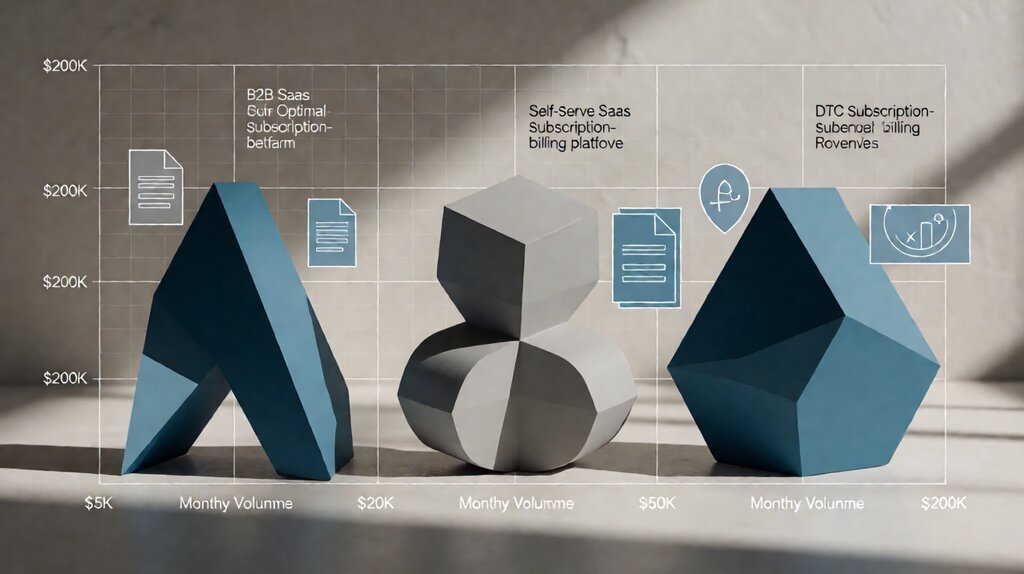
Three SaaS use-case profiles cover most SMB operators.
B2B SaaS with quote-to-cash + multi-element contracts. Chargebee Performance. The quote-to-cash flow includes proposal templates, signature collection (DocuSign + Chargebee integration), hosted invoicing, and the conversion of won deals into subscriptions. The multi-element allocation engine handles SaaS + setup + training + support bundle pricing.
Self-serve SaaS with monthly + annual plans. Stripe Billing. The Stripe Checkout flow captures the customer’s card, picks the plan, applies a discount code, and routes to the platform’s subscription record. The integration with Stripe Payments + Stripe Tax + Stripe Revenue Recognition is canonical; the alternative (Chargebee + Stripe) adds integration overhead.
DTC subscription box on a custom stack. Recurly Professional. The churn analytics help operators tune the customer journey; the multi-currency support covers international subscriber bases; the dunning email templates are tuned for consumer subscribers (less formal than B2B).
DTC subscription box on Shopify. Recharge or Bold Subscriptions. Recharge charges $99-$499/month flat + 0.5% of transaction and integrates with Shopify’s checkout; Bold is similar. Both are Shopify-specific; both are cheaper than Recurly for low-volume Shopify stores.
DTC subscription box specifics
For DTC subscription box operators, the subscription billing decision differs from B2B SaaS in three ways.
Volume and subscriber count. DTC box operators often have 1K-50K subscribers at $20-$50/month. The platform’s per-subscriber fee matters differently than in B2B SaaS. Recurly and Chargebee have per-subscriber caps that kick in at 10K-50K subscribers.
Churn sensitivity. DTC box operators see 5-15% monthly churn (vs 1-3% monthly churn in B2B SaaS). The platform’s dunning and churn analytics are operational, not nice-to-have. Recurly’s Recurly Benchmarks report is the canonical industry reference; Recurly’s analytics is the deepest.
Subscription model shape. DTC box operators often offer “subscribe and save” + “every X weeks” + “gift subscriptions” + “build your own box”. The platform’s flexibility on plan structure matters more than in B2B SaaS. Recurly handles the model shapes well; Stripe Billing’s custom usage-based support is lighter.
For a DTC subscription box operator at $50K monthly volume with 5K subscribers, the choice is Recurly Professional ($600/month platform + $1,750/month processor = $2,350/month) vs Shopify Recharge for Shopify-hosted ($99-$499/month flat + 0.5% of transaction = $250-$750/month total) vs Paddle merchant-of-record at 5% + $0.50 ($2,925/month total). Recharge is the cheapest if Shopify-hosted; Recurly is the canonical for non-Shopify DTC box operators.
Membership sites and online courses
For membership sites and online courses, the subscription billing layer is part of a larger stack that includes content delivery + member authentication.
For WordPress membership sites. MemberPress + Stripe is the canonical stack. MemberPress handles the membership tiers, content dripping, paywall rules; Stripe handles the recurring billing. Total: MemberPress $199/year + Stripe’s standard 2.9% + $0.30. The alternative — Memberful — is a SaaS membership layer that handles the content access control + Stripe-bundled billing.
For online course platforms with subscription tiers. Thinkific + Stripe, Teachable + Stripe, or Kajabi (all-in-one). For a course platform with monthly subscription tiers (vs one-time course purchase), the recurrence is small (typically 3-12 months). The platform’s billing stack is one of the three above; the choice depends on other features.
For pure SaaS subscription tiers. The platform of choice is the same as B2B SaaS (Stripe Billing, Chargebee, Recurly). The membership site pattern is just a special case of SaaS subscription.
What to consider at scale
Two operational concerns that emerge at $100K+ MRR.
Revenue recognition automation. For a SaaS with 60% annual contracts (the B2B SaaS default), the deferred-revenue balance at $100K MRR runs $250K-$400K. Manual journal entries are too slow; the operator needs Stripe Revenue Recognition, Chargebee’s accounting export, or Maxio. Maxio is the canonical answer at $1M+ annual revenue.
Multi-currency support. For a SaaS operator with 30% of customers in EU/UK/Australia, the multi-currency support matters. Stripe Billing handles multi-currency natively (since Stripe Payments handles it); Chargebee Performance and Recurly Professional both have multi-currency. The differentiator is the customer’s payment experience in their local currency.
The cost math at each volume
Three SaaS operator profiles cover most cases.
$5K MRR / 100 subscribers at $50. Stripe Billing = $35/month + $175/month processor = $210/month. Chargebee Starter = $37.50/month + $175 = $212.50/month. Recurly Starter = $45/month + $175 = $220/month. Stripe Billing is the cheapest; Chargebee Starter is comparable with better features if you grow.
$30K MRR / 600 subscribers at $50. Stripe Billing = $210/month + $1,050/month = $1,260/month. Chargebee Performance = $300/month + $1,050 = $1,350/month. Recurly Professional = $360/month + $1,050 = $1,410/month. Stripe Billing is the cheapest; Chargebee Performance for quote-to-cash.
$100K MRR / 2,000 subscribers at $50. Stripe Billing = $700/month + $3,500/month = $4,200/month. Chargebee Enterprise at 1.5% on revenue above $100K drops to 0.6%; the math gets complex at this MRR. Sales-negotiated custom pricing kicks in.
The honest traps at scale
Three operational surprises for SaaS operators at scale.
Trap 1: revenue percentage compounds with growth. At 0.7% / 1.0% / 1.2% per-transaction, a SaaS at $1M annual revenue pays $84K / $120K / $144K to its billing platform per year (vs $7K / $10K / $12K at $100K). The cost ratio is high; consider Maxio (flat-fee) at this scale.
Trap 2: sales tax + VAT add-ons stack. Stripe Tax + Stripe Revenue Recognition + Stripe Sigma (legacy) on top of Stripe Billing adds $200-$400/month at $40K MRR. The bundle is cheaper on Chargebee Performance (where revenue recognition is included).
Trap 3: churn rate matters more than MRR. Two SaaS operators at $30K MRR but one has 3% monthly churn and the other has 8% monthly churn. The 8% operator is in trouble; the platform’s smart-retry layer is the lever. The 3% operator can stay on Stripe Billing cheap.
Pick the right subscription billing platform for your SaaS
Pick Stripe Billing ($0 + 0.7% of revenue) if you’re a US SaaS operator below $1M annual revenue running Stripe as your payment processor. The canonical answer for SMB SaaS.
Pick Chargebee Performance (1.0% of revenue) if you’re a B2B SaaS operator with quote-to-cash, multi-element contracts, and custom hosted pages. The canonical answer for mid-market B2B SaaS.
Pick Recurly Professional (1.2% of revenue) if you’re a DTC subscription box operator at $30K+ monthly volume. The churn analytics surface operational improvements.
Pick Shopify + Recharge ($99-$499/month + 0.5%) if you’re a DTC subscription box on Shopify.
Pick Maxio ($1.5K-$5K/month) if you’re at $1M+ annual revenue and need audited revenue recognition + ARR reporting.
For the cost math at each tier and the overage per-transaction fees at high volumes, the subscription billing pricing page covers the math. For the practical 3-way comparison of Stripe Billing, Chargebee, and Recurly on tier and features, the Stripe Billing vs Chargebee vs Recurly page runs the comparison. For the broader coverage of merchant-of-record (Paddle, Lemon Squeezy) and niche vendors (Memberful, Recharge), the best subscription billing software for small business comparison covers the math.
For the LLC-related subscription billing setup (invoicing + W-9 + state-side of payments), the payment processor for an LLC page covers the operational setup. For the ecommerce subscription box side (Shopify + Recharge + payment processor), the payment processor for ecommerce page walks through the integration.
For the broader entity definition of subscription billing end-to-end (which the SaaS setup flow operationalizes), the what is subscription billing page walks through the lifecycle step by step.
Last updated: October 2026